Understand everyday products
Twenty-five product entries explain what vinegar, baking soda, peroxide, bleach, WD-40 and the rest actually are. Each one says what the product is good for and where it does harm.
Part II · 25 products
THE HOUSEHOLD CHEMISTRY BIBLE DIGITAL GUIDE ONE-TIME PURCHASE
The practical household reference guide
Discover what everyday products can really do, which surfaces they can damage, and the mistakes worth avoiding — all in one easy-to-use reference handbook.
One-time purchase • Digital download • No subscription
Preview the guide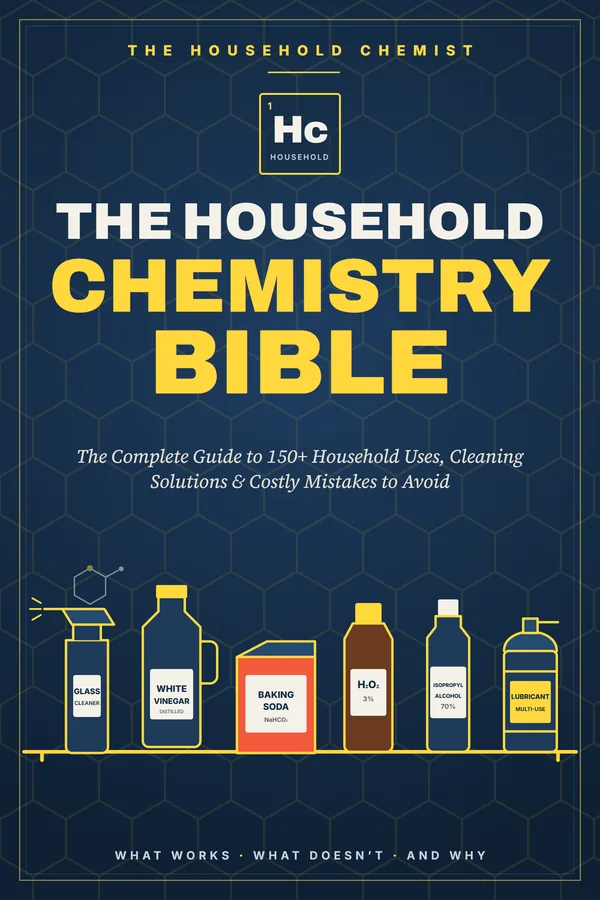
One video says vinegar cleans everything. Another warns that it etches marble. The bottle under your sink has a label in small print that never quite answers your question. And the specialty cleaner on the shelf promises a lot more than it explains.
The problem isn't that you need more cleaning hacks. You need a trustworthy way to know which advice applies to your home.
Introducing
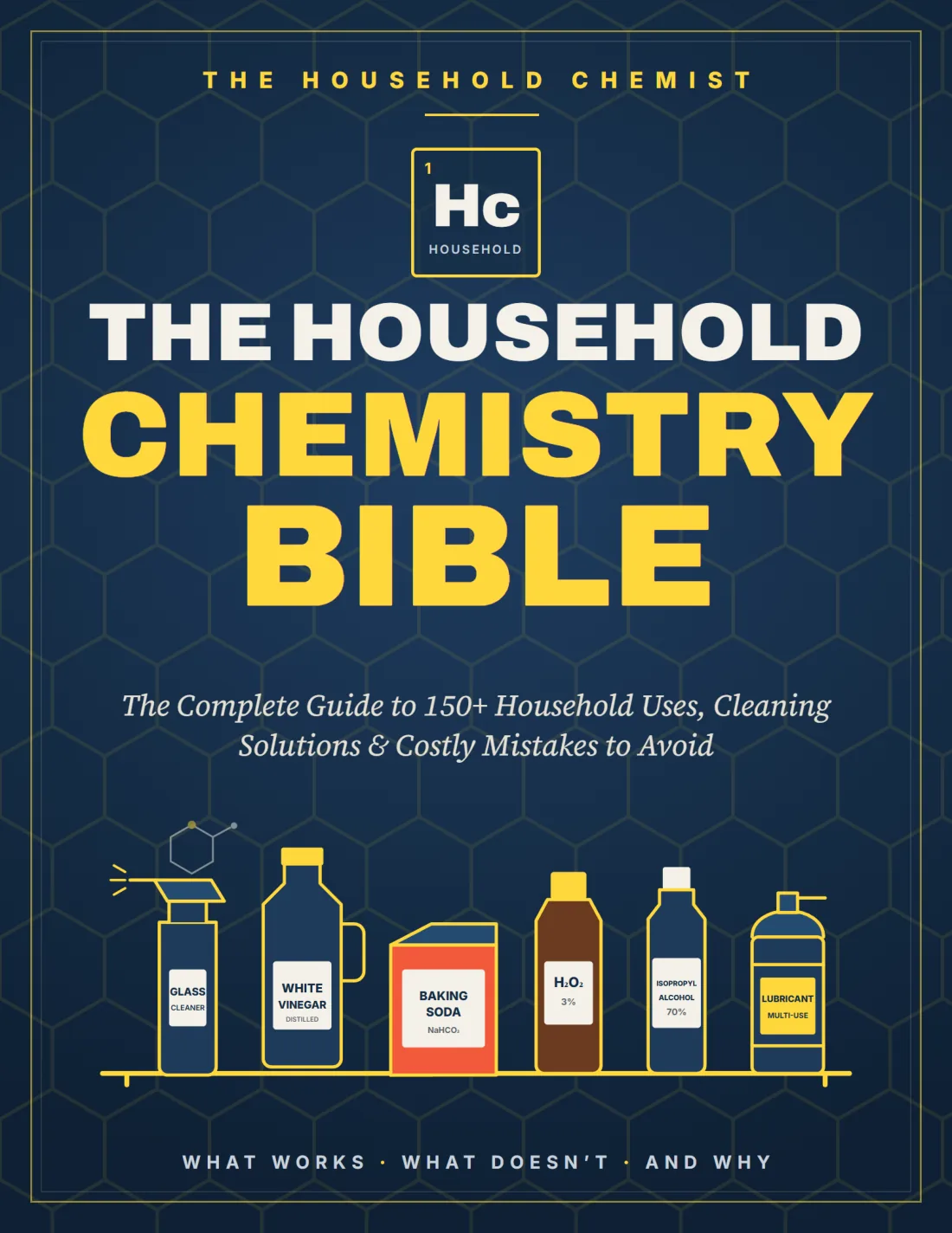
One practical handbook designed to help you choose appropriate products, understand common cleaning mistakes, and make smarter household decisions.
Find evidence-supported uses for familiar products, each with a rating and the source behind it.
See each product's limits, the materials it can damage, and what it must never be combined with.
Look things up by product, problem or surface, with cross-references, four indexes and clickable contents.
Six practical things the handbook is built for, every one based on what is actually inside.
Twenty-five product entries explain what vinegar, baking soda, peroxide, bleach, WD-40 and the rest actually are. Each one says what the product is good for and where it does harm.
Part II · 25 products
Fifty mistakes that damage surfaces, waste money or create a hazard, each with the better alternative. A one-page checklist covers what to know before you clean anything new.
Part VI · 50 mistakes
A compatibility matrix and 25 surface guides show what is generally suitable, what needs care and what to keep off. Where the material makers disagree, the guide tells you so.
Part V · 25 surfaces
Start from what you see: soap scum, hard-water crust, grease, cloudy glass, odors, stains. Eighteen problem guides and a 20-entry stain guide walk you through it.
Part IV · 18 guides + 20 stains
A short essential supply list and a budget cabinet plan help you stop buying cleaners that duplicate each other. The worksheet uses your own prices, so you can judge cost per use yourself.
Part IX · supply list and worksheet
Every file is a PDF you keep, so it works without a connection. Print the charts and checklists and tape them inside the cabinet door.
PDF · prints on US Letter
482 pages in ten parts. Page numbers are from the finished PDF.
pH, acids and bases, surfactants, solvents, abrasives, oxidizers and hard water, in plain English. Also why popular cleaning tricks sometimes fail, and seven questions for choosing the right product.
White vinegar, baking soda, hydrogen peroxide, rubbing alcohol, dish soap, washing soda, Epsom salt, bleach and disinfectants, WD-40 and lubricants, and 14 specialty products. Each entry follows the same layout: what it is, what it does, how to use it safely, what to avoid and what never to combine.
Evidence-checked household uses in 15 categories, from kitchen and bathroom to laundry, appliances and the garage. Each one covers the problem, the method, the expected outcome, its limitations and warnings, and its sources.
A quick-reference table, then full guides for soap scum, mineral scale, grease, baked-on residue, cloudy glass, odors, sticky residue, rust, mildew and more. A fabric stain guide is organized by stain type.
A matrix of 25 surfaces against 14 common products, readable in black-and-white print. Then a guide for each material: granite, marble, quartz, laminate, stainless steel, wood, vinyl, tile, grout, glass, acrylic, metals, fabrics, plastics and screens.
How the wrong product or method damages stone, wood, metal, glass, floors, fabrics and appliances, with the better alternative for each. Includes the one-page "Before You Clean Anything" checklist.
Popular claims, each given a verdict (false, misleading, partly true or depends), with what the evidence actually supports. A section lists 20 popular uses that did not pass the evidence check, and why.
Reading labels and signal words, combinations to avoid, storage, ventilation, protective equipment, children and pets, disposal, and when to call a professional. It ends with a printable emergency reference page.
An essential supply list, a budget-friendly cabinet with a cost-comparison worksheet, weekly, monthly and seasonal checklists, a product inventory, and cut-out compatibility reference cards.
A plain-English glossary, indexes by product, problem, surface and warning, the full source list with web addresses and access dates, and the research methodology.
One-time purchase • Digital download • No subscription
Real pages from the finished PDFs. They are shown as previews: links inside them work only in the full file.
Want the complete reference guide?
Get the Full Handbook — $37Three everyday questions, and where the handbook sends you. It won't promise a result. It gives you the information to choose well.
The countertop question
You have a spray cleaner and a vanity that might be marble. The guide starts with telling marble from granite, because the answer depends on it: acids such as vinegar and lemon can etch calcium-based stone.
The stubborn stain
A blood or milk stain needs a different approach from grease or dye, and heat can make some stains harder to remove. The stain guide sorts stains by type before it suggests a method, and it checks the fabric first.
The confusing internet hack
The fizzing looks impressive. Chemically, the two neutralize each other into mostly water, salt and carbon dioxide. The handbook explains what is happening and what to use instead.
Six PDF files and the cover image, delivered as downloads. Page counts are from the finished files.
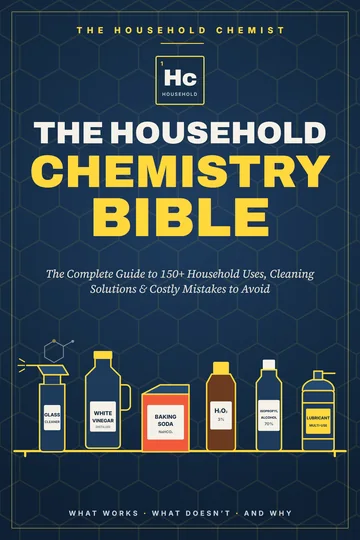
Main handbook
The complete illustrated reference, built for reading on a computer or tablet, with clickable contents, cross-references with page numbers, four indexes and PDF bookmarks.
Bonus 1
Product cards, surface charts, the top mistakes, safety reminders and a short glossary, for when you need an answer in seconds.
16 pages · PDF · printable
Bonus 2
Diagnosis and surface-identification worksheets, a cleaning log, a product inventory, routines, an expense tracker and notes pages.
27 pages · PDF · printable
Bonus 3
Surfaces against common products, materials that need extra caution, pairings to check on the label, and combinations to avoid.
18 pages · PDF · printable
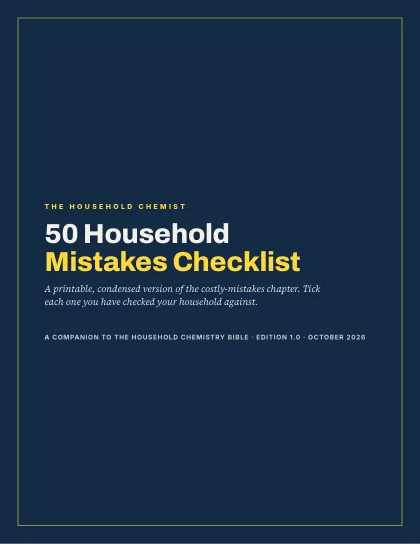
Bonus 4
The mistakes chapter condensed to a printable checklist you can work through room by room.
5 pages · PDF · printable
Plenty of good advice is free. The difference is having it organized, sourced and in one place.
| What you need | Scattered online advice | The Household Chemistry Bible |
|---|---|---|
| Information organized in one place | Spread across many sites and videos | One handbook, ten parts |
| Product-specific explanations | Varies by source | 25 product entries in one format |
| Surface compatibility guidance | Often missing from a quick tip | Matrix and 25 surface guides |
| Offline reference | Usually needs a connection | PDFs you keep |
| Printable checklists | Sometimes | Four printable bonuses |
| Sources and limitations stated | Sometimes | Every entry cites its sources |
| Easy topic navigation | Search and hope | Clickable contents, four indexes |
| Cost | Free | $37, one time |

About The Household Chemist
The Household Chemist is an educational channel and reference series about the products people already own: what they can do, what they can't, and why. It is presented by Walter Bennett, who explains the chemistry in plain English and is quick to say when a popular trick doesn't hold up.
The handbook isn't built on anyone's say-so, including his. It is built on published sources:
Sources come from manufacturers' published guidance, the EPA, CDC, CPSC and OSHA, poison control centers, university extension services and trade bodies such as the Natural Stone Institute. All 184 are listed in Part X with their web addresses and access dates.
Much of it, yes, in pieces and often contradicting itself. The handbook saves you the searching. It gathers the guidance, rates it, states its limits and lists its sources, all in one place you can return to.
You don't need to be. Every term is explained in everyday language, with diagrams for the few ideas that matter most. Most entries start with the practical answer, then explain why.
Good. The guide is about using what you own well: what each product suits, where it does damage, and which ones duplicate each other.
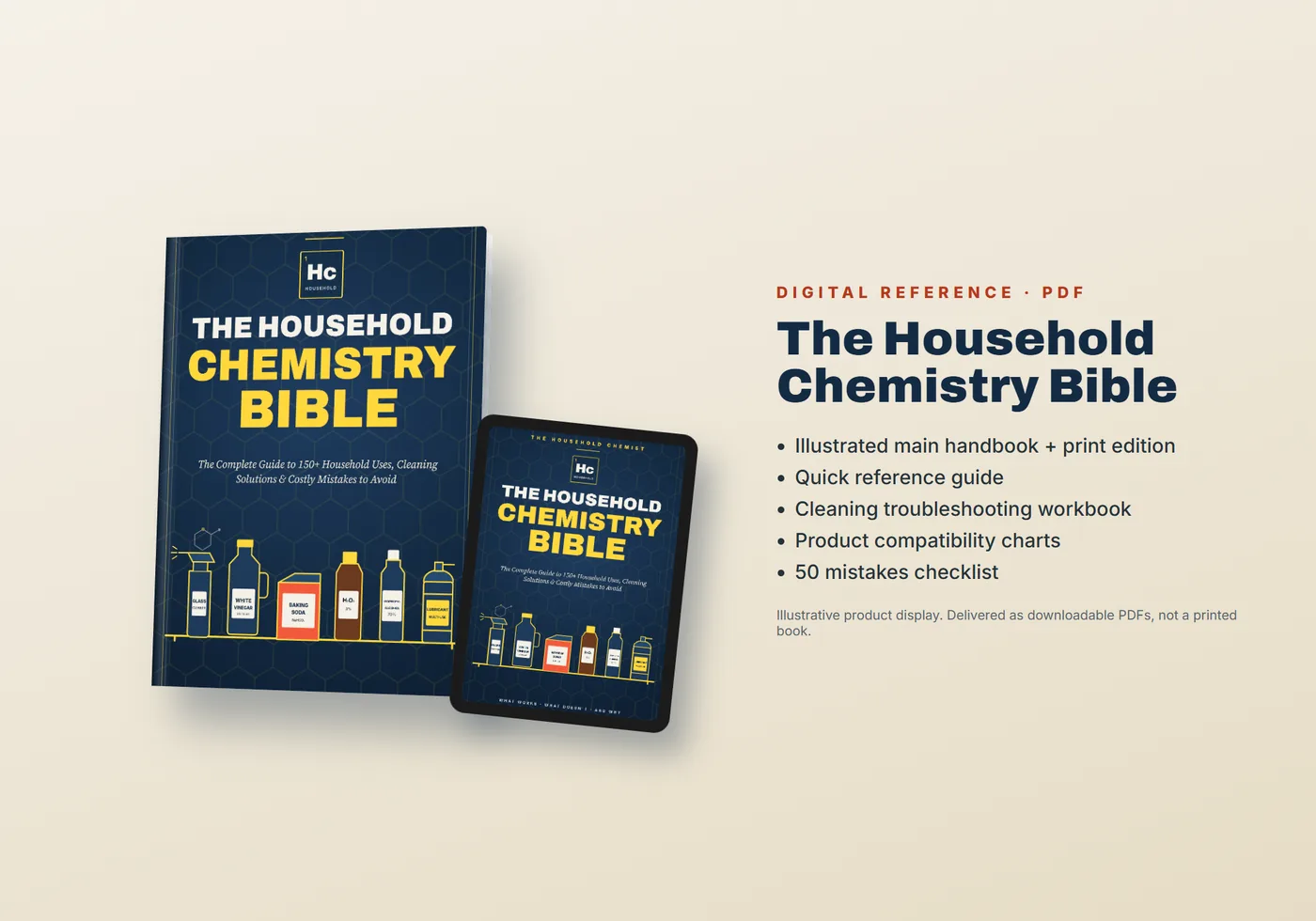
No. It's a set of PDF files you download after purchase: the handbook, a print edition and four bonuses.
Yes. The print edition uses white pages and outlined boxes to save ink, and every bonus is designed to print.
Yes, in any PDF reader. The pages are US Letter, so a tablet or computer is more comfortable for long reading. A reader with bookmarks makes phone navigation easy.
No. It's a one-time purchase, and the files are yours to keep.
No. It's an educational reference. It doesn't replace product labels, the care instructions from the maker of your surfaces, or professional assessment, and it says so throughout.
Your practical household reference system, available to download and keep.
Secure checkout • Digital download • No subscription
Refunds: see the refund policy.
Get a quick guide to common household product and surface compatibility considerations.
Six PDF files: the 482-page main handbook, a 481-page print edition, and four bonuses: the Quick Reference (16 pages), the Troubleshooting Workbook (27), the Compatibility Charts (18) and the 50 Mistakes Checklist (5). The cover image is included too.
No. Nothing is shipped. It's a digital product you download.
After checkout you receive the files as downloads from the store. Keep the receipt email, which also links to your files.
Yes. Use the print edition for the handbook, print at "Actual size" on US Letter, or use "Fit to page" on A4. All four bonuses are designed for printing.
Yes. Once the files are downloaded, nothing needs an internet connection.
Yes, in any PDF reader, such as Apple Books, Adobe Acrobat Reader, Google Drive or your phone's built-in viewer. The bookmarks panel makes navigation much easier on a small screen.
Yes. No chemistry background is assumed. Every technical term is explained, and the glossary collects them.
Yes: 167 of them in Part III, each with a method, the expected outcome, limitations, warnings and sources. A further 20 popular uses that failed the evidence check are listed separately with the reason.
Yes. Every product and application carries warnings, Part VIII covers chemical safety in detail, and there's a printable emergency reference page.
No. It does the opposite. It explains which combinations to never make and why, and it contains no recipes for homemade disinfectants or mixtures to store.
No. The label on the product you're holding always comes first, and so do the care instructions from the maker of your surface. The handbook says this throughout.
Yes. All four bonuses are part of the $37 purchase. There are no add-ons or upsells.
This is Edition 1.0. No update policy has been announced, so please don't buy expecting future editions.
No. You pay once and keep the files.
The refund terms are shown on the store page before you pay, and in the refund policy.
Reply to your purchase receipt email, and it will reach us.
Keep practical household chemistry, product guidance and important cleaning precautions together in one reference you can return to whenever you need it.
$37 one-time
Get The Household Chemistry Bible — $37Digital download • No subscription • Printable resources